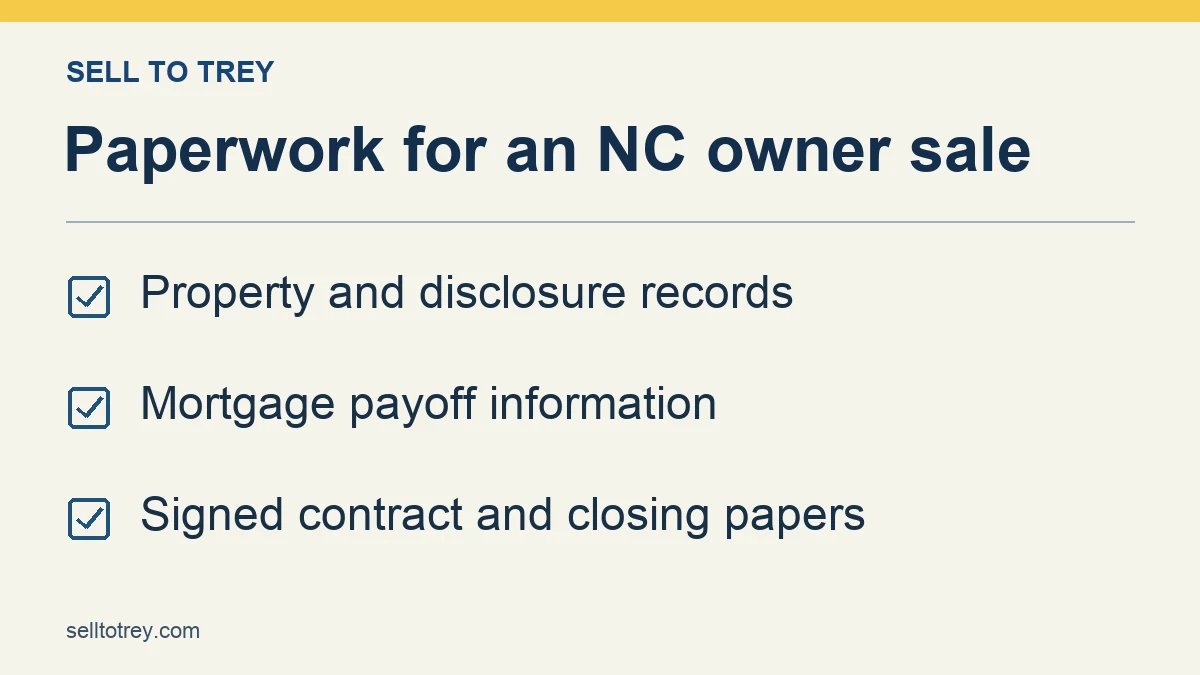
You can sell your North Carolina house without hiring a listing agent. You still need to work out which disclosures apply, put the agreement in writing, and arrange the legal work for closing. Start a folder before you take offers so you can answer questions without hunting through old loan statements.
This checklist covers common residential sales. A condo, estate, trust, occupied rental or property with title problems may need additional records and legal work. Use it to prepare for a conversation with your North Carolina closing lawyer, rather than as a complete list for every property.
Start with the disclosures that apply to your sale
North Carolina’s Residential Property Disclosure Act covers specified transfers of residential property with one to four dwelling units, with or without a broker. For a covered sale, the owner supplies the Residential Property and Owners’ Association Disclosure Statement and the separate Mineral and Oil and Gas Rights Mandatory Disclosure Statement.
Check the exemption before skipping a form. Chapter 47E exempts certain court-ordered, fiduciary, co-owner and family transfers. A first sale of a never-inhabited dwelling and certain other transfers can qualify for an exemption from the ordinary property disclosure while still requiring the mineral form. The exact transaction matters; an inherited house does not establish an exemption by itself. See Chapter 47E, sections 1–2.
Deliver applicable statements no later than the time the buyer makes an offer. Preparing them earlier gives the buyer time to read them. Late delivery can create a limited cancellation right under G.S. 47E-5.
Use the current Commission form and follow each question’s answer choices. “Not Applicable” appears only where the form allows it. Attach explanations or supporting reports for “Yes” answers as the instructions require.
The ordinary form permits “No Representation” answers, including when an owner has knowledge. That choice does not authorize false statements or concealment, and a broker has separate duties. Correct material inaccuracies promptly.
The mineral form limits “No Representation” to a previous owner’s severance of rights. It is not an available substitute for answering about your own past severance or intended severance.
For covered pre-1978 housing, prepare the lead packet before signing
Federal lead rules apply to most housing built before 1978, with exceptions. Before the buyer signs the contract, provide the EPA lead pamphlet, disclose known lead-based paint and hazards, and supply available records and reports. The contract needs the prescribed lead warning and acknowledgments.
Give the buyer the required opportunity for a lead inspection or risk assessment, generally ten days. The parties can agree in writing to a different period, and the buyer can waive the opportunity. The disclosure rule does not require you to order new lead testing. Check the EPA’s requirements and exemptions for your sale.
Gather the property and payoff records
Keep these together, even if some do not apply to your house:
Your current deed, legal description, any existing survey, and documents showing authority to sign for a trust, estate or entity.
Mortgage and HELOC account details, plus information about other liens. Ask the lender for a payoff valid through the expected closing date; a monthly balance is not a payoff quote. Confirm account closure and release requirements for any credit line.
The latest property tax bill and any unpaid assessments or notices.
HOA or condo declarations, dues, approved special assessments, transfer charges and association contact information.
Permits, repair invoices, warranties and inspection reports you already have. For a rental, include the lease, rent records and security-deposit information.
A prior survey or inspection can help identify questions, but the buyer, lender or closing lawyer may need more work. Ask before paying for a new report.
Put the terms in the contract, then let counsel handle the legal work
Have a North Carolina lawyer review the proposed agreement before you sign. The contract should address the property and parties, price, deposit or due diligence arrangements, inspection and financing terms, items that stay, possession, closing date, expenses and remedies if someone fails to perform. Standard licensed forms exist; this guide does not reproduce a contract or replace advice about its terms.
A North Carolina lawyer must provide the necessary legal services, including legal advice, deed preparation for others and title opinions. Limited nonlawyer roles can include presenting documents, directing signatures and handling funds without practicing law. The requirement does not mean the lawyer must personally perform every signing or funds task. See the NC State Bar’s closing opinion.
Ask who will handle title issues, obtain payoffs, prepare the deed and coordinate recording and disbursement. Counsel should confirm execution, delivery and registration requirements. Recording protects interests against certain creditors and purchasers under G.S. 47-18. A bill of sale may document personal property; it does not replace a real estate deed.
Ask for a seller net estimate before accepting the price
Selling by owner does not establish a fixed commission saving. Commission and buyer-agent compensation depend on the agreements you make, and compensation is negotiable. Request an itemized estimate that includes agreed compensation, legal and recording charges, prorated taxes, HOA charges, concessions and lien payoffs. Separate the mortgage payoff from transaction fees so you can see what each amount represents.
For a taxable North Carolina conveyance, the state excise tax is $1 for each $500 of consideration or value, including a fraction of $500. A taxable $300,000 transfer produces $600 of state excise tax; a fraction above that amount adds another $1. The transferor pays before recording. G.S. 105-228.30 sets the charge, and G.S. 105-228.29 lists exemptions, including certain gifts and inheritance transfers. Ask counsel about other charges applicable to the property.
Before signing, compare the final settlement statement with the contract and your net estimate. Resolve unfamiliar fees, payoff differences and possession arrangements. Keep the signed agreement and amendments, disclosures, settlement statement, deed copy, payoff records and any Form 1099-S. Ask when you should expect confirmation of recording and loan releases.
If you are comparing a direct sale with selling by owner, read how a cash-buying company sale works. A cash offer still needs a written agreement, disclosures where required, and proper closing work.
Have a house to sell?
Learn about selling to Sell To Trey and ask questions about your property.